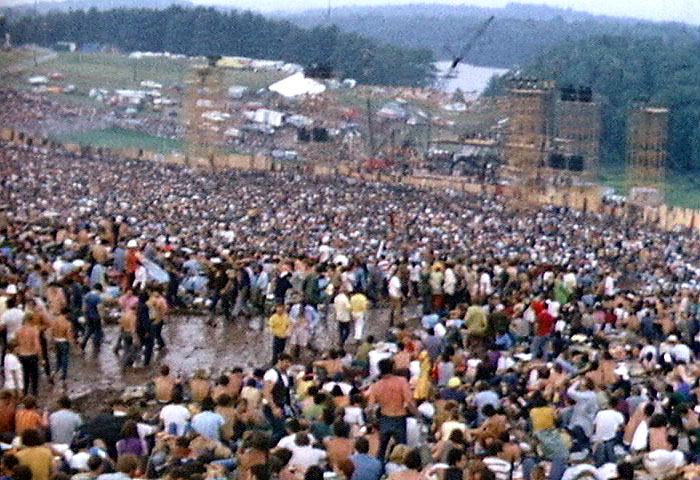
In August of 1969, the Woodstock Music & Art Fair in Bethel, New York, welcomed famed singer and guitarist Jimi Hendrix to conclude the festivities. While the crowds were dense, 400,000 to 500,000 attendees had already left after the three-day event was pushed into a fourth day due to delays. As a result, hundreds of thousands missed what would become, by many accounts, Hendrix’s most iconic performance of all time.
Hendrix’s set lasted nearly two hours alongside a newly assembled group called Gypsy Sun and Rainbows. In addition to his established hits, Hendrix introduced unreleased music and improv.
However, his rendition of America’s national anthem was what took attendees and later the public by surprise. With America embroiled in the Vietnam War, Hendrix’s unique take on “The Star-Spangled Banner” drew attention for more than just its melody.
What Woodstock Was All About
Woodstock was a music festival and hallmark of 1960s counterculture. Held on a 600-acre dairy farm, it welcomed hundreds of thousands of people. The venue couldn’t handle the unexpected influx, and fences and barriers were later taken down to accommodate the crowds.
More than 30 acts played over the weekend, including a bevy of famous names. Among them were Janis Joplin, Creedence Clearwater Revival, The Who, and of course, Hendrix himself. Even though the event was a failure in terms of finances, losing more than a million dollars, it remains an iconic symbol of the hippie movement.
Hendrix’s Career in 1969
By the time Woodstock came around in the late ’60s, Hendrix had already gained fame as an international recording artist. His group, the Jimi Hendrix Experience, released three studio albums up to that point: Are You Experienced and Axis: Bold as Love in 1967, then Electric Ladyland in 1968. All three hit the top five on the American album charts, and Electric Ladyland took the number one spot. However, Experience didn’t make it to Woodstock.
In fact, the dissolution was still fresh when Hendrix arrived at Woodstock. Bassist Noel Redding left in June, less than two months prior to Hendrix’s iconic appearance, which forced Hendrix to reconsider his musical direction and work with other musicians.
Despite the turmoil, Woodstock still secured him for $18,000. This was the highest performance fee of any artist the event had booked.
Because he wouldn’t be performing with the established Jimi Hendrix Experience group, he spent the weeks before Woodstock assembling Gypsy Sun and Rainbows.
Experienced drummer Mitch Mitchell stayed with Hendrix, joined by bassist Billy Cox, whom Hendrix had known since his time in the military. Another longtime acquaintance, Larry Lee, joined with his guitar alongside percussionists Juma Sultan and Jerry Velez.
Hendrix had formerly worked with a three-piece band, so the inclusion of a second guitar and an additional percussionist opened up new arrangement possibilities. When it came to creative arrangements, Hendrix was about to transform Woodstock’s ideas about music.
August 18, 1969: Hendrix’s Take on the National Anthem
Due to thunderstorms and technical difficulties (as well as scheduling problems that would make the news in their own right), Woodstock delayed Hendrix’s performance, which was meant to close the festival. Estimates vary, but it is generally believed that only 30,000 to 40,000 attendees remained to wait for Hendrix’s performance out of as many as 500,000.
Those who remained encountered a set of music both old and new. Hendrix opened with “Message to Love,” a recent composition that would later appear on the live album Band of Gypsys in 1970. Classics like “Spanish Castle Magic” and “Red House” intermingled with new material, like “Izabella” and “Jam Back at the House.”
Hendrix passed the spotlight to other members of the group; Larry Lee took lead vocals for “Mastermind,” and a large portion of the set featured instrumental passages. Within these, Hendrix bent the strings and used amplifier feedback and distortion to warp the music to his tastes. While this was already his established style, he took those abilities further.
Hendrix wound down his performance with an instrumental version of “The Star-Spangled Banner” as part of an extended musical sequence including other compositions like “Purple Haze.” The majority of the anthem was made of nothing but Hendrix’s electric guitar. The sounds he produced using feedback, altered pitches, distortion, bending, and other techniques mimicked the sounds of sirens and explosions.
It was these particular sounds that grabbed public attention after the festival’s conclusion. Because Hendrix had woven in noises that resembled bombs and aircraft, some commentators interpreted his performance as a critique of American involvement in the Vietnam War. This aligned with Woodstock’s peace- and communal-focused identity.
Hendrix himself pushed back against these claims. At a press conference in Harlem the following month, Hendrix explained that he had not intended to call the country’s ideals into question.
Rather, he meant to reflect what he viewed as the current atmosphere in America, which he described as “slightly static.” A week later, he discussed on The Dick Cavett Show that he played the anthem because he was American and had grown up singing it in school. Cavett called the arrangement unorthodox, but Hendrix disagreed, saying he “thought it was beautiful.”
Though only a fraction of the attendees remained for Hendrix’s rendition of the national anthem compared to the crowds at the start of the festival, the recording gained widespread traction.
Even decades later in 1999, Experience Hendrix and MCA Records created Live at Woodstock, a two-CD collection that included previously unreleased material from that August morning. Hendrix would not be alive to see his national anthem soar to such long-standing acclaim; he passed away on September 18, 1970, at the age of 27.
Though his performance was received with an unpredictable response from the crowd and commentators alike, Hendrix stood by his creation. Whether it reflected sentiment on the Vietnam War or simply demonstrated the unique approach to guitar for which Hendrix was known, his version of the anthem remains an iconic piece of both Woodstock history and rock-and-roll’s roots.